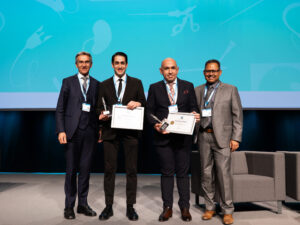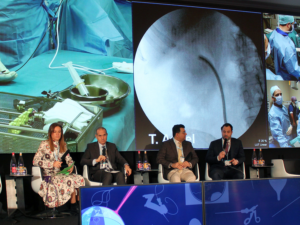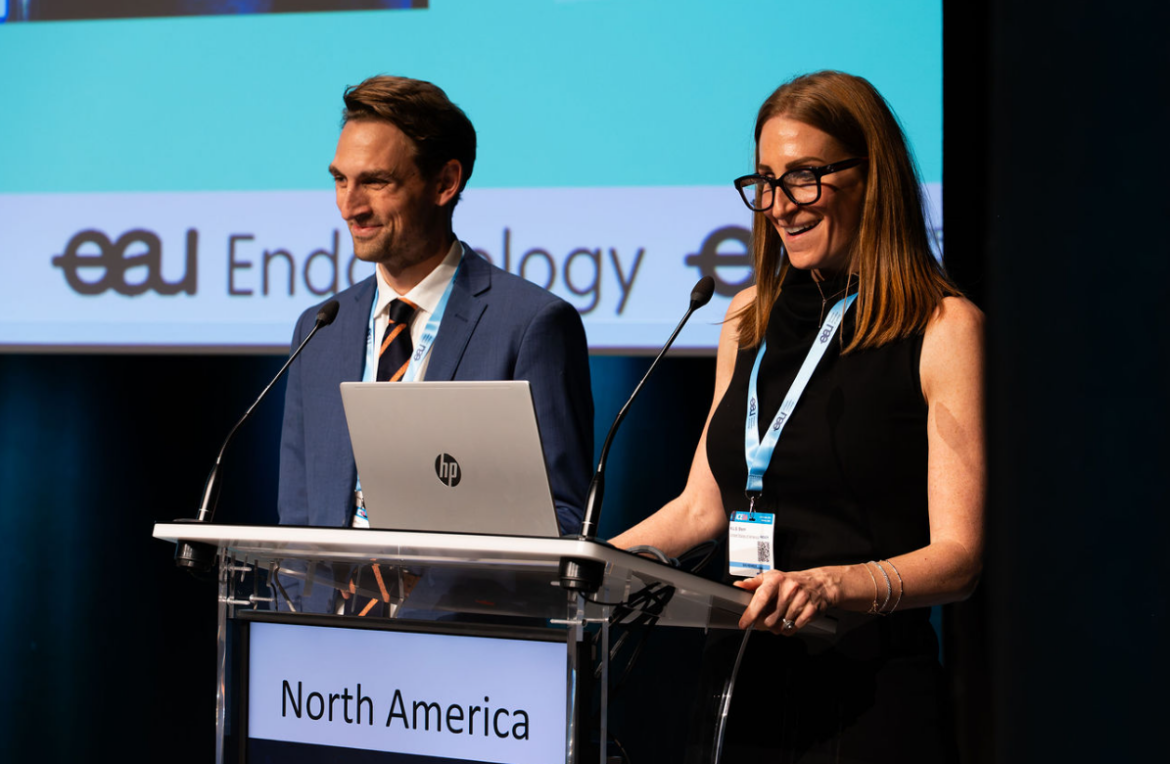
In a repeat from the first edition in Rome, ICE26 features a tweaked version of the international “Best Urologist” challenge. Rather than featuring individual “Titans”, this year saw teams of two representing Europe, North and South America, Asia and the wider Africa-Middle East-Central Asia region facing off in a series of challenges.
On each of the first congress days, the audience picked a topic that the teams would have 90 minutes to prepare a presentation on, with no access to the internet or other resources. The audience would then vote on the best presentation and crown the winners the “Best Endourologist of 2026”. The winner will be announced during the ICE26 Awards Session in Auditorium 1 on Saturday morning from 10:00 to 10:30.
Towards 2030
The first topic that the speakers were assigned on Thursday morning was: “Stone surgery in 2030, what is your vision for the future?” This led to a diverse series of off-the-cuff talks. It should be said that the teams were also kept apart from any on-going presentations so they were unaware of what their competitors had covered.
The South American team, consisting of Dr. Luis Rico (Caba, AR) and Dr. Catalina Solano Mendoza, (Medellín, CO) started by pointing out current challenges and developments that could address them in the coming four years. For stones, recurrence, the stone-free rate and management of complications remained the biggest challenges and clear improvement was needed. New technologies have already started to enter the ORs, such as UAS, basketing, suction (FANS/DISS), and systems with integrated suction and irrigation systems.
The team identified robotic platforms as having the potential to improve precision and ergonomics of operations, as well as developments in miniaturisation. With aspiration and irrigation integrated into these platforms, the “2030” vision is smart endourology, with high degrees of control over surgical procedures.
The North American team, Dr. Karen Stern (Phoenix, US) and Dr. Kevin Wymer (Rochester, US) made the case for improving the prediction of which stones to treat: which are non-obstructive, which procedure is best? More data meant that it is no longer three simple treatment options. By 2030, models and patient data would help urologists select the right approach. Stent choice and new stent types would also help in managing pain. Perhaps stents could be avoided altogether. Improving ergonomics for surgeons and a practical approach to accurately counsel a patient would further improve care by 2030.
Representing the most populous continent of Asia, Dr. Sung Yong Cho (Seoul, KR) and Prof. Anil Shrestha (Kathmandu, NP) suggested clarifying established technologies. The coming four years would be an opportune time for clinical tests and trials. For instance in determining the best ways to increase the stone-free rate, making surgery safer through stone recognition and AI, working more with patient-reported outcome measures and reducing costs to make care more widely available.
Prof. Shrestha expected major changes in stone treatment already over the course of the next four years, with an expanded role for ureteroscopy, lasers and scopes. Pulsed lasers has already changed lithotripsy and ever finer dust and a decrease in thermal injuries are already big improvements. Further miniaturization might not be the biggest priority, but more capable scopes are.
Representing a territory that could be broadly (and generously) defined as “the Greater Middle East” Dr. Wissam Kamal (Jeddah, SA) and Dr. Arman Tsaturyan (Yerevan, AM) gave a dynamic talk with hand-drawn illustrations and relying on their “human intellect” to counteract the influence of any Artifical Intelligence in the research and presentation progress. “What will the standard of care be in 2030? How do we kill off PCNL, after Prof. Traxer announced its death in 2024?” Dr. Tsaturyan asked.
In order to decrease complications, further standardization of relatively new technologies like FANS are necessary, as settings like aspiration have not been standardised yet, and the long-term effects of long operative time are not yet known. AI will be able to help decrease this time, and the team also placed much faith in the rapid maturation of “micro robots” to assist in endourological cases.
Dr. Joyce Baard (Amsterdam, NL) and Dr. Steeve Doizi (Paris, FR) representing the EAU’s home continent, pointed out that the choice by this audience meant that there were certain unmet needs that a relatively near future could be addressing. The team covered, among others, improvements in imaging and 3D-modelling of patient-specific upper urinary tracts.
Prof. Traxer thanked all participants for this first session, saying that it was not an easy exercise. “The reason why we call people experts, they can give these kinds of talks with little to no preparation. And this is a skill that we practice every day when we answer our residents’ questions.”
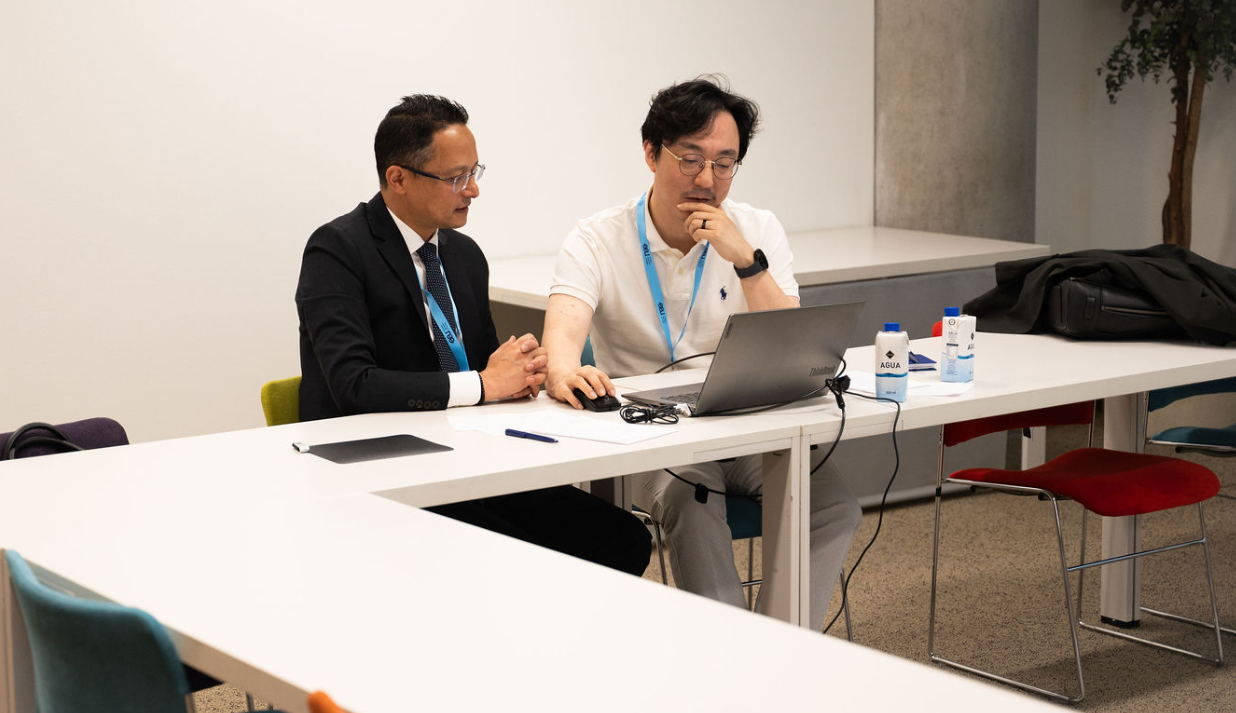
“Team Asia” prepares their presentation in a secluded room.
Stone analysis: still needed?
On Friday morning, the Titans were (in reversed order) tasked to answer the question: “Stone Analysis (composition): do we need it?”
In a conversational style, the European candidates discussed the merits of stone analysis, using a hypothetical case discussion to make their points. In conclusion, with little getting in the way of treatment, and with the promise of ever-more sophisticated technology, the team decided that it was still needed “today”.
The contestants from the Africa-Middle East-Central Asia region also concluded that it was still necessary and very important for preventing recurrence. Similarly, with high case loads in Asia, a continent that contains 60% of the world’s population and a significant part of the “stone belt”, patients are happy to know more about their specific urinary stones as part of reaching “complete treatment” (which should be considered incomplete without prevention).
With some caveats, the North American team were the only team to say ‘no’ to the need for analysis. While it is still being practiced, also in North America (because patients want it and it can serve as a ‘knowledge check’), in most cases the type of stone can already be assumed based on other factors, and 24-hour urine collection can also tell you most of the information. Stone analysis does not change the management either and can even be highly inaccurate due to heterogeneity of the stone. Analysis creates extra costs for the system and (in some case) for the patient as well. Unless the stones have been formed by medication or if it’s a cystine stone that transforms into a brushite stone, analysis is not needed as it does not change management.
The South American team tied their talk to their 2030 vision of the day before. “One of our objectives was ‘less stone recurrence’, and prevention and metabolic management is important to achieve this. Hence, we say yes to stone analysis.”
In order to achieve 2030 zero stone-free rate. Not done. We still need stone analysis and patient evaluation to see QoL impact of our treatment options. We need both urine analysis 24h and stone analysis. Analysis also serves to train students (and AI!) to recognise stones and how to use the Daudon classification. It also helps urologists better inform and teach their patients.
Prof. Traxer again thanked all the participants, and with a second round of secret voting, the “Best Endourologist 2026” challenge was at an end. The winner will be announced tomorrow!

Audience members vote.