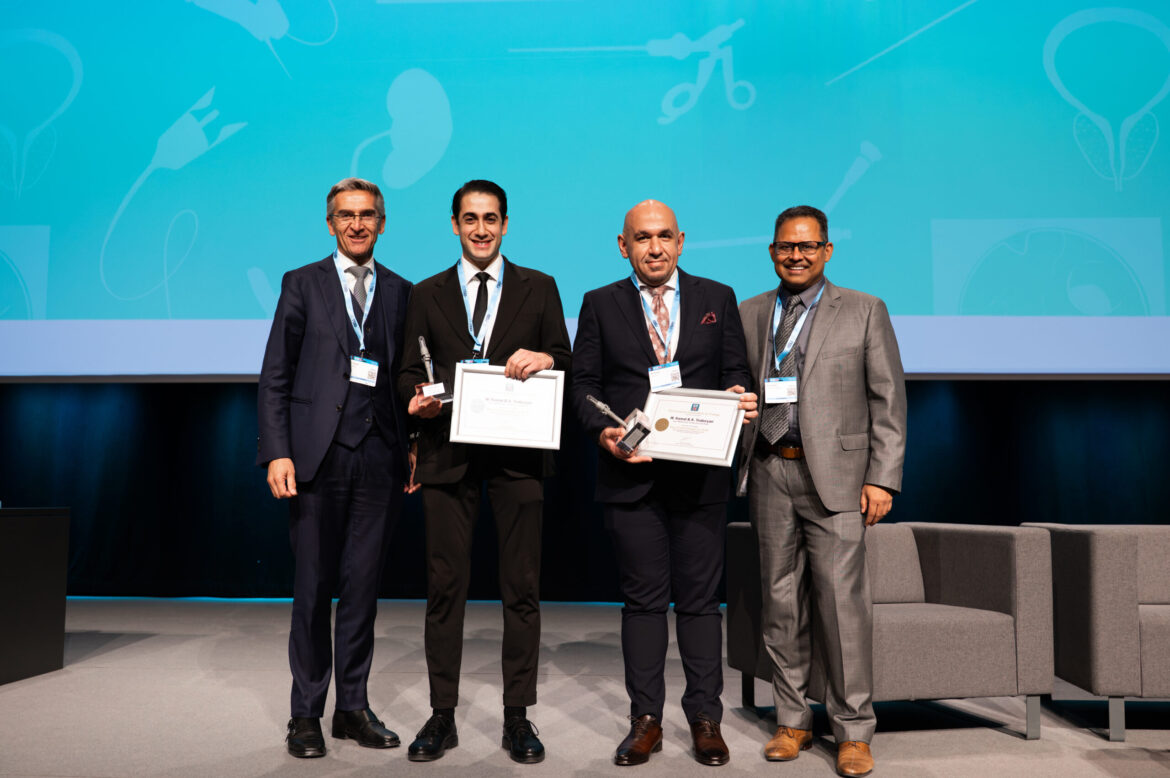
On Saturday morning, on the third and final day of ICE26 in Valencia, Endourology Section chair Prof. Olivier Traxer (Paris, FR) opened the Awards Session where endourologists and other innovators were honoured for their achievements. The awards are modelled on the iconic electrode that was used with the HM3 lithotripter, in Prof. Traxer’s words a “perfect symbol of minimally-invasive surgery, endourology and of course technology.”
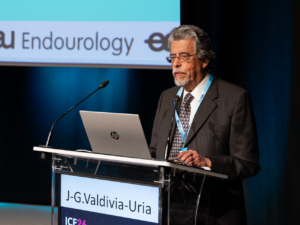
This year’s winner of the recently-instituted Endourology Section Lifetime Achievement Award is Prof. José Gabriel Valdivia Uría, the surgeon who developed a technique of percutaneous renal access with the patient in supine position in 1988. The Valdivia technique, in various forms is still used to this day. Read more in this separate article.
Best Endourologist
Representing the Middle East, Africa and Central Asia
- Wissam Kamal, Jeddah (SA)
- Arman Tsaturyan, Yerevan (AM)
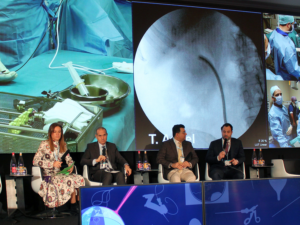
The winner of this year’s “Clash of the Titans”, by total popular vote over two presentations was the team of Dr. Kamal and Dr. Tsaturyan, representing the Middle East, Africa and Central Asia. Prof. Traxer complimented all teams for taking part and being put on the spot throughout ICE26.
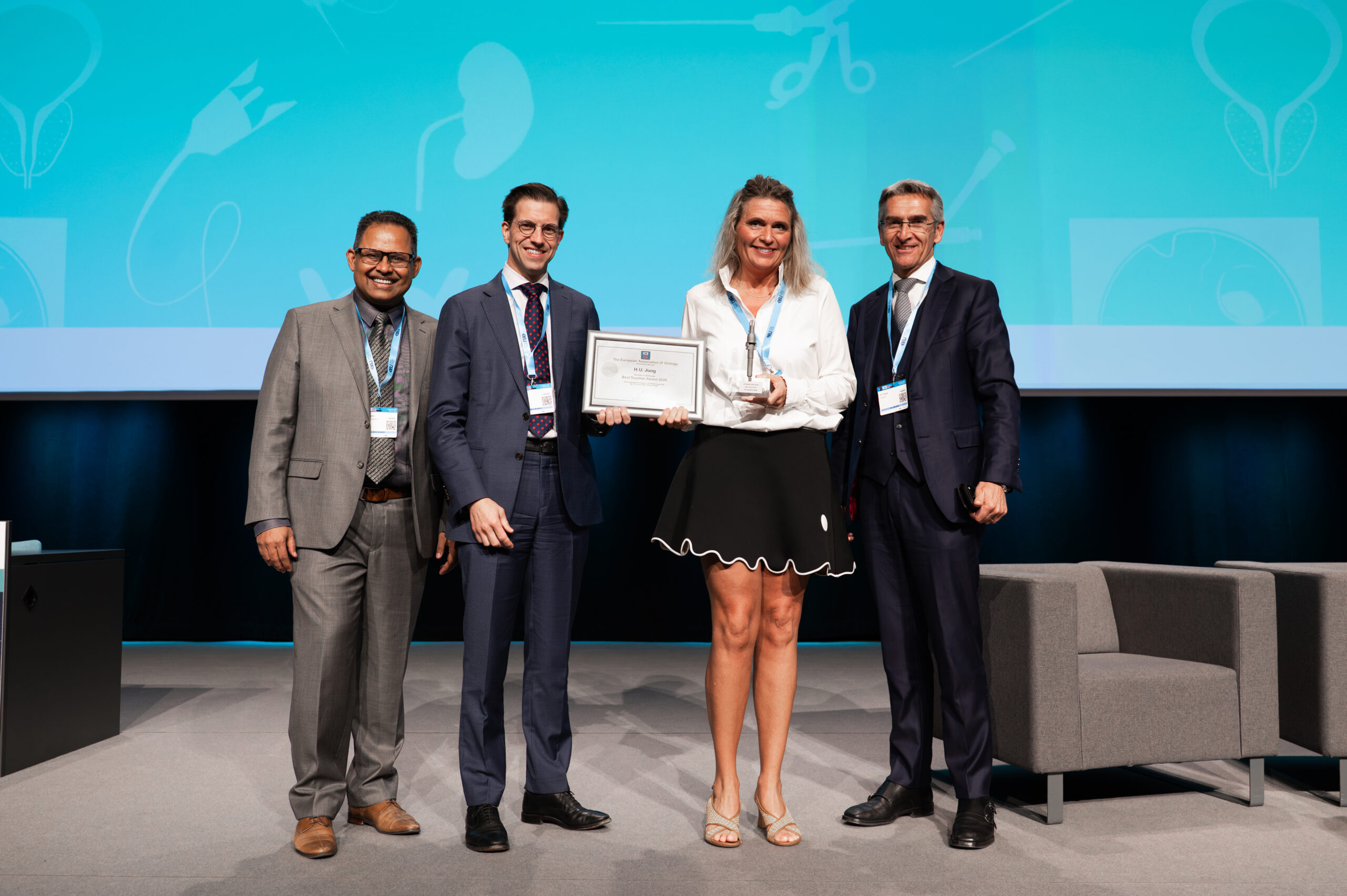
Best Teacher Award
Dr. Helene Jung, Vejle (DK)
Dr. Thomas Tailly (Ghent, BE) introduced Dr. Jung and explained the objective criteria that ESU faculty members are graded on, saying Dr. Jung was extremely deserving of the prize. Dr. Jung thanked her “fantastic colleagues” and explained that she always tried “to be enthusiastic when teaching, to give a little bit of myself, and to make teaching more inspiring to my colleagues.”
Separately, Prof. Traxer complimented Dr. Jung’s work as an educator. “Helene is a fantastic teacher and soon she will be appointed full professor, taking the place of our friend Prof. Palle Osther. As an academic she’s really involved in education a lot, internationally especially the ESU Courses. It’s an ‘objective’ prize but we are happy to confirm, that she is a very deserving winner.”
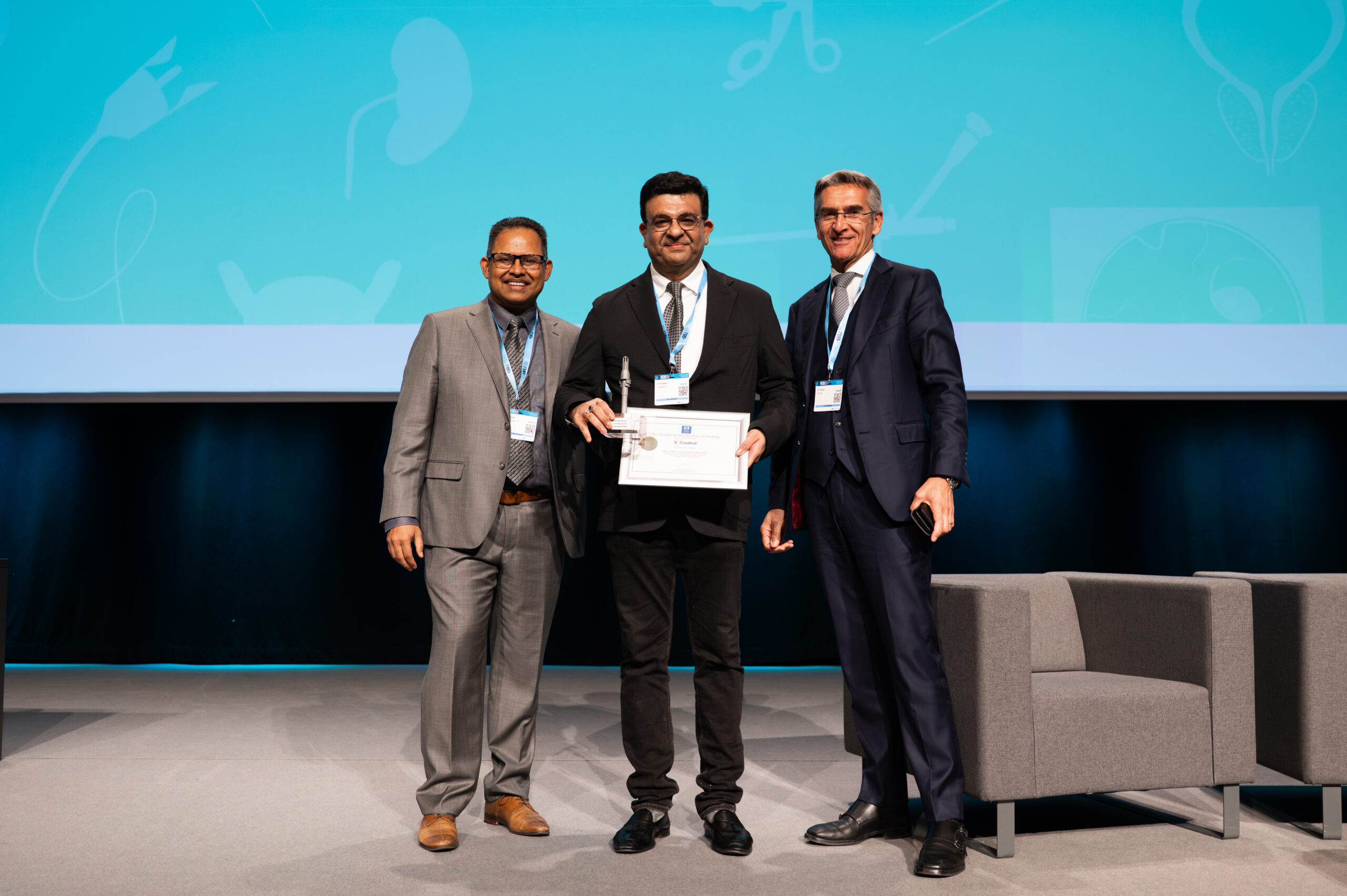
Best Researcher Award
Dr. Vineet Gauhar, Singapore (SG)
Prof. Bhaskar Somani (Southampton, GB) commended Dr. Gauhar, saying there was “no competition, in my mind” when it came to appointing the best researcher this year. Dr. Gauhar had been a clinician for many years before relatively recently switching to research, but already within the last 5-6 years his impact has been “phenomenal”, contributing to 20 global registries in 80 countries. Prof. Somani crowned Dr. Gauhar the “King of Suction”.
Dr. Gauhar thanked the EAU’s Endourology Section, in particular Profs. Traxer and Somani for supporting him. “The award is also for all people I work with in those 80 countries. I would like to dedicate it to my late father.”
Prof. Traxer described Dr. Gauhar as “one of the top people conducting research in our field, he is a machine. This win does not come as a surprise. For next year he is blacklisted!”
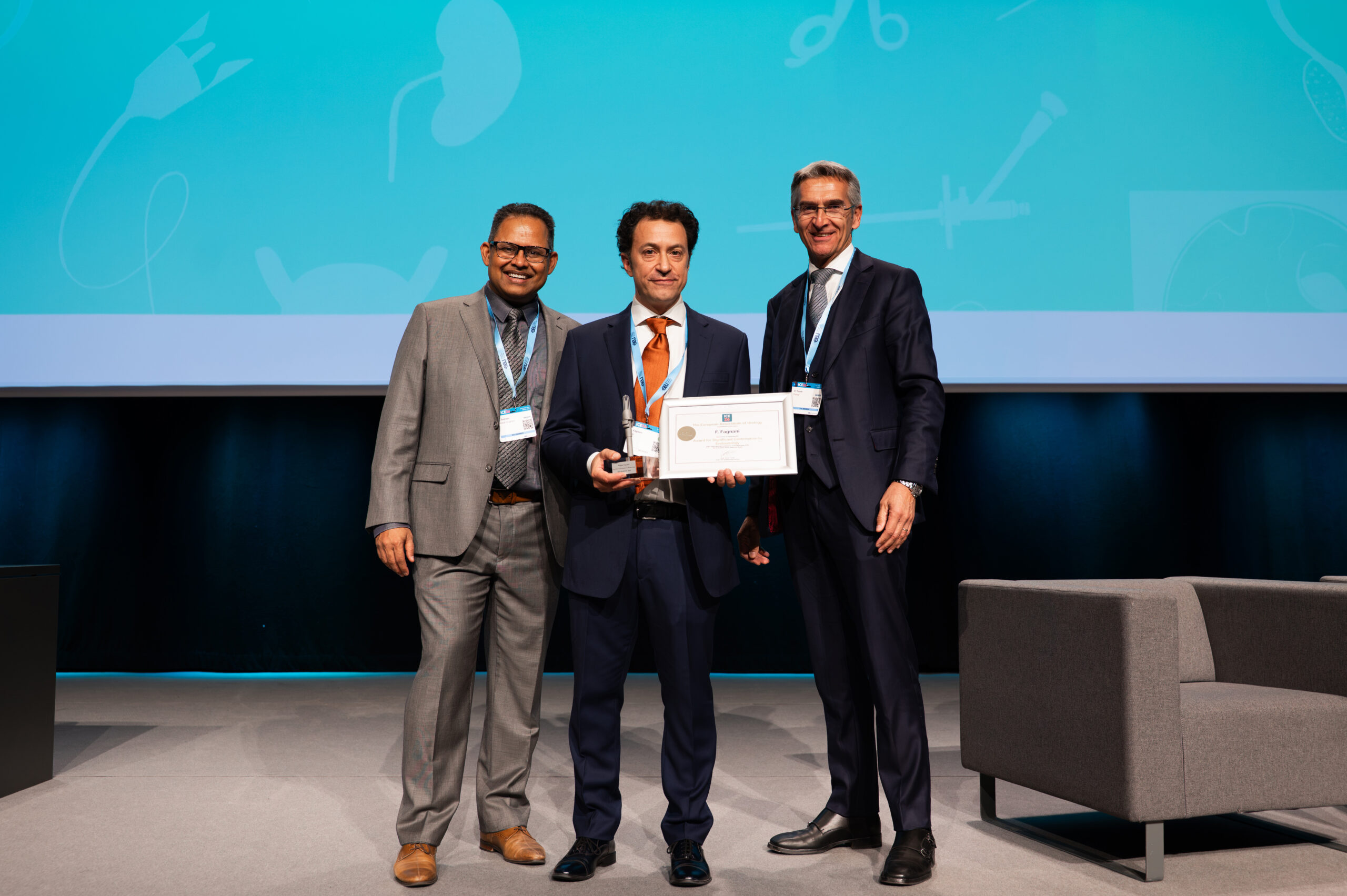
Significant Contribution to Endourology
Mr. Filippo Fagnani, Milan (IT)
Mr. Filipo Fagnani gave a brief presentation on his career as an engineer. “Most of you studied medicine, I studied engineering. You treat patients, we measure and build. But we share a passion, a kind of love. We believe technology, when used well, can make people’s lives better. That’s the reason I’m standing here.”
“I consider myself the bridge between physics and clinical practice. Together we turn knowledge into tools. These technologies we create, start not in my desk but with you, turning ideas into instruments.”
Prof. Traxer explained that while he selects this prize, “so it’s not so objective, but knowing many people in the industry, Filippo Fagnani is a medical engineer, who really did a lot for endourology and endourologists, for a long time with laser technology, and before that in SWL.”
“Filippo is very knowledgeable on endourology, stones, and importantly he knows what we need in terms of concept, in terms of technology, he’s doing an excellent job at Quanta. Filippo is always happy to collaborate, to listen to us and to make changes.”